‘The Yugas’
by Joseph Selbie and David Steinmetz
If like me you enjoy learning history and about understanding human behaviour and consciousness, then you will probably love this book.
 Did humans with higher levels of consciousness live long ago?
If you ever wondered how structures like the Pyramids were built when we do not have the technology today to construct them as built, then this book offers some big clues, that for some people are hard to accept as it involves exploring the possibility and some would say the probability that humans who lived 12,000 years ago may well have had some technologies that were superior to the silicon-based technologies that we have today, Graham Hancock’s Netflix series Ancient Apocalypse which is detested by mainstream archaeologists because it challenges their model of human history in the same way that Copernicus and Galileo were vilified in their day by the mainstream astronomers for claiming that the Earth was not at the centre of the Solar System. However, Hancock’s series is loved by many others as it presents a wealth of credible evidence that points to the reality that there were ‘smarter humans’ operating from a higher level of consciousness, many thousands of years ago… and so does The Yugas!
Understanding our past, present and future!
Yugas are ancient Indian time cycles that describe how humanity moves through repeating ages of higher and lower consciousness from spiritual wisdom, down into materialism, and back up again. Where civilisations and societies rise and fall in long, repeating cycles somewhat like seasons, but on a scale that transcends all of human history including periods where they are little or no written records.
Building The Ancient Pyramids was IMPOSSIBLE?
This video short highlights something that only The Yugas can begin to explain …
https://youtube.com/shorts/zmChehKEiMY?si=RFmP9DftWQDtXdfe
Mark Twain’s famous quote has some truth …“History Doesn’t Repeat Itself, but It Often Rhymes”
So, when trying to make sense of many of the crazy goings on in today’s world, rather than looking at specific events repeating, I like to study human history and its patterns and cyclical pendulums. This of course arguably enables us to make some more educated ‘best guesses’ about what our future holds.
The idea behind the Yugas is that human civilisation is not progressing in a straight line, but instead moving through cycles of awakening, forgetting, and reawakening.
Each Yuga age influences the level of:
- human consciousness
- technology
- spirituality
- social structure
- scientific understanding
I have previously reviewed books that identify patterns like The Fourth Turning’
Such books tend to focus on predicting economic upturns and downturns however, the Yugas are time cycles on much grander scale, that come from ancient texts, that could easily be categorised as ‘spiritual texts’ because like many other ancient spiritual texts they contain great wisdom. But the Yugas capture the essence of human consciousness
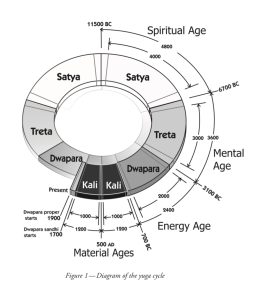
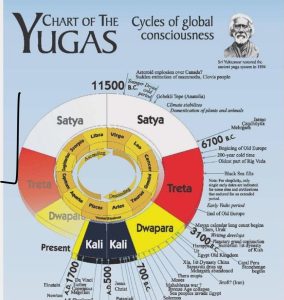
As shown in this illustration that comes with the book, just as the year has spring, summer, autumn, and winter, the Yuga cycle has four ages, each with its own qualities:
- Satya Yuga — the Spiritual Age 11,500 BC to 6700 BC
People are highly aware, peaceful, wise, and intuitive. - Treta Yuga — the Mental Age 6700 BC to 3100 BC
Human intelligence is strong, societies are organized, and early sciences develop. - Dwapara Yuga — the Energy Age
Descending Dwapara Yuga 3100 BC to 700 BC
Ascending Dwapara Yuga1700 AD (1900 AD Proper) to 3700 AD
Present-day 2025 is early Dwapara Yuga
People learn to understand energy and technology. Communication and knowledge expand rapidly. - Kali Yuga — the Material Ages
Descending Kali Yuga 700 BC to 500 AD
Ascending Kali Yuga 500AD to 1700 AD
Awareness is at its lowest. Society becomes focused on material things, conflict, and survival.
These four ages make up one full cycle, and after the darkest age (Kali), the cycle begins rising again.
Credibility of The Yugas
The authors, Joseph Selbie and David Steinmetz believe the model’s credibility rests on several pillars:
- Consistency with observed history
The sweeping rises and collapses of human knowledge—such as the fall of Rome, the Renaissance, and the scientific revolution—fit neatly into the ascending/descending Yuga framework. - Cross-cultural cyclic myths
Many ancient civilizations described time as cyclical: the Greeks (Ages of Man), the Maya (Long Count cycles), and the Egyptians (Zep Tepi cycles). This cross-cultural parallel is presented as supporting evidence. - Archaeological anomalies
Advanced stonework, prehistoric maps, and unexplained astronomical alignments suggest that ancient cultures knew far more than conventional history acknowledges, consistent with a descending Satya-to-Kali pattern. - Predictive clarity
Yukteswar’s dating places the beginning of the ascending Dwapara Yuga at AD 1700, which aligns strikingly with the real-world surge in scientific discovery, global interconnection, and technological innovation.
 Where the Modern Yuga Interpretation Comes From
The modern reinterpretation of the Yuga cycle that The Yugas is based on does not come from traditional Hindu cosmology alone. Instead, it is taken from Sri Yukteswar’s 1894 book ‘The Holy Science’, where he proposed a dramatically different understanding of the Yuga timeline. . Yukteswar said the Yugas repeat every 24,000 years in ascending and descending cycles. This book expands upon the teachings of Yukteswar, a yogi who was said to have channelled much of his knowledge and wisdom.
Sri Yukteswar’s Radical Reinterpretation of The Yugas in The Holy Science, Yukteswar claims that:
- Humanity moves through ascending and descending cycles of consciousness.
- The full Yuga cycle is 24,000 years, rather than the millions of years described by orthodox Hinduism.
- The cycle corresponds to the solar system’s movement around a companion star, influencing the level of subtle cosmic energy reaching Earth, which in turn affects human consciousness.
This is the sort of book that is totally fascinating but a lot to take in in one sitting, so I would recommend dipping into it over time and digesting its content slowly.