
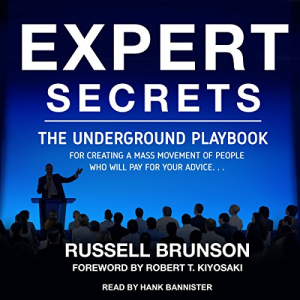
Expert Secrets
By Russell Brunson
Recently, I applied some of the knowledge from this book to the sales processes of three of my clients. The result was an increase in their monthly sales conversion numbers by 10% to a whopping 200%.
How is this possible?
Firstly, I have re‑read this book four times in order to fully assimilate the content.
Secondly, the core ideas that drive much of Brunson’s approach can be summarized in three key words: “Elephants”, “Monkeys”, and “Stories.”
 This is a book review with a difference, because instead of just summarizing the key learnings from the book, for this particular book, I am going to share with you ‘A REAL CASE STUDY EXAMPLE’ where I have applied Russel Brunson’s teachings using the “Monkeys, Elephants and Stories’ metaphor.
Russell Brunson is among the greatest marketing experts in modern history when it comes to understanding and explaining “why people buy — or do not buy — any given product or service.”
Like me, Brunson is fundamentally a mindset and business structure expert. My specialty is “Greater Purpose Business mindset and structures,” while Brunson’s expertise lies in mindset and sales funnels.
Sales funnels are the lifeblood of every business. Brunson deeply understands how to structure effective funnels and, more importantly, the mental and emotional drivers that move people from being potential prospects to becoming raving‑fan clients.
At the heart of Brunson’s work is the importance of “making a difference” and “having an impact.” This sense of authenticity is one of the essential reasons why Russell is possibly one of the greatest sales and marketing experts of our time.
If there were a “Mount Rushmore” of the four greatest marketing geniuses in history, the first name on the list in my opinion would be David Ogilvy, who died in 1999 and is widely known as “The Father of Advertising.”
The second would be the irrepressible Dan Kennedy, who is also the mentor of the third name on my list — Russell Brunson.
There are a number of strong contenders for the fourth position, but that is a debate for another time.
At only 45 years old, Brunson has already achieved an extraordinary amount. Much of this success comes from the fact that he is an exceptional teacher who deeply understands the psychology of selling, which brings me back to the earlier concept of “Elephants”, “Monkeys”, and “Stories.”
The Elephant and the Monkey
This metaphor describes two aspects of human psychology.
The “elephant” represents our powerful unconscious mind, while the “monkey” represents our less powerful conscious mind.
The monkey is effectively tied to the back of the elephant. Even if the monkey wants to go south, if the elephant is moving north, they will both end up going north.
Most people in marketing and sales focus their communication on the monkey — the conscious mind. This works perfectly well if the elephant (the unconscious mind) is already heading in the direction of wanting the product or service.
However, if the elephant is heading in a different direction, communicating with the monkey becomes largely ineffective. No matter how logical or persuasive the argument may be, the elephant ultimately determines the direction.
Understanding this psychological dynamic is one of the most powerful insights in Expert Secrets.
A Practical Case Study Example
To demonstrate how powerful the ideas in this book can be, instead of providing my usual summary of the contents, I want to share a real case study from one of my own clients.
This client owns a long‑established classic car business in the United States, and the example illustrates how the “elephant and monkey” metaphor works in practice.
Imagine you are a classic car dealer looking to buy rare Ferraris from potential sellers.
In some situations, the seller has already decided they want to sell the car before you even begin the conversation. When this happens, their “elephant” (unconscious mind) is already heading in the right direction.
At that point, your monkey (conscious mind) can negotiate with their monkey, discussing price, timing, and terms.
However, in many situations the seller’s monkey may be perfectly happy to talk about how you could buy the car or sell it on their behalf, but their elephant is not moving in that direction.
In these situations, no matter what you say to the monkey, the deal will not happen.
For example, the seller may say “the timing isn’t right” or talk about wanting an unrealistic price. In reality, the true reason they cannot sell may be something far more emotional.
Very often, the seller has an emotional attachment to the car, and in many cases they may not even be fully conscious of this attachment themselves.
The key is to identify and understand “the story” running in their unconscious mind (the story guiding their elephant).
For instance, you might ask:
“What does this car mean to you?”
The response might be:
“My late father gave it to me.”
Now you understand the real reason the car cannot be sold. The issue has nothing to do with market price or timing.
In the seller’s unconscious mind, the story is:
“Selling this car would be like selling a part of my father.”
At this point, the key is not to argue with the monkey. Instead, you provide the elephant with a new and compelling story.
For example, you might say:
“One of our clients had a similar situation. He asked himself what would my dad have wanted me to do with the car? His answer was to sell it and use the money to set up a college fund for his grandchildren. That’s what he decided to do. What do you think your dad might say if he were still here?”
Now the conversation has moved to a completely different level.
‘Their elephant’ (their powerful unconscious mind) is now empowered to rewrite the story, which can ultimately change its direction. Only once this shift occurs can the seller genuinely consider selling the car.
Why This Example Matters!
This is just one example of how I have applied the lessons in this book to help several businesses improve their sales performance. The book contains many other powerful tools, insights, and practical strategies.
Now let me share some of the key learnings in the book:
Core Premise of the Book
If you can articulate a problem, provide a new opportunity, and guide people through a transformation, you can build a loyal audience and a profitable business.
Brunson emphasizes that expertise is not limited to world-class authorities or celebrities. Instead, expertise is often relative! If you know more than the people you want to help and can guide them through a process, you can serve them effectively.
He encourages readers to see themselves as leaders of a movement, not merely sellers of information, products and services.
The Concept of the “Mass Movement”
One of the most important ideas in the book is Brunson’s concept of a mass movement.
A mass movement consists of three essential elements:
- A charismatic leader (expert)
- A future-based cause
- A new opportunity
The charismatic leader is the person who guides the audience toward a new vision. The future-based cause is the shared goal or transformation people want to achieve. The new opportunity represents the unique solution the leader offers.
According to Brunson, successful businesses are often built around movements rather than products. People rally behind ideas that promise a better future.
Examples in many industries illustrate this principle like fitness movements, business coaching communities, and personal development organizations all revolve around a leader who communicates a compelling vision.
The New Opportunity Concept
One of Brunson’s most powerful insights is the idea of “the new opportunity.”
Rather than competing directly with existing solutions, successful experts frame their offer as a new and better way to achieve a desired result.
For example, instead of selling a generic “weight loss program,” a marketer might introduce a new concept or method that differentiates their approach.
The new opportunity has several key characteristics:
- It challenges the status quo.
- It reframes the problem.
- It presents a simpler or more effective path to results.
Brunson explains that people are often tired of existing solutions but still deeply desire the outcome. By presenting a new opportunity, the expert positions themselves as the guide who can lead people toward a better result.
The Importance of Storytelling
A major portion of the book focuses on storytelling.
Brunson argues that stories are far more persuasive than facts or logical arguments. Stories create emotional connection and help audiences understand complex ideas in a relatable way.
Epiphany Bridge Story.
Brunson introduces the concept of the “Epiphany Bridge Story.”
This type of story explains the moment when the expert discovered the insight or method that changed everything for them. By sharing this transformation journey, the expert allows the audience to see themselves in the story.
The Epiphany Bridge typically includes:
- The backstory (the struggles before the discovery)
- The moment of realization
- The transformation that followed
- The desire to help others achieve the same result
This storytelling structure is used widely in online marketing because it builds trust and emotional engagement.
The Attractive Character
Another key concept in ‘Expert Secrets’ is the ‘Attractive Character’.
Brunson explains that people connect with personalities more than they connect with brands or companies. The Attractive Character is the persona that the expert presents to their audience.
The goal is not to appear perfect or distant, but to be relatable and authentic.
Brunson identifies several types of Attractive Characters, including:
- The leader
- The adventurer or crusader
- The reluctant hero
- The reporter or interviewer
Each archetype resonates with different audiences, but the essential element is authenticity. Audiences are drawn to people who share their experiences openly and communicate their beliefs clearly.
The Value Ladder
Another important concept Brunson discusses is the Value Ladder, a business model that organizes products and services into different levels of value and investment.
The Value Ladder typically starts with lower-cost or free offerings that attract a large audience. As customers experience results and build trust, they may choose to move to higher-value offerings such as coaching, events, or premium programs.
This approach allows entrepreneurs to:
- Build relationships gradually
- Serve people at different levels of commitment
- Create scalable business growth
By guiding customers through a structured journey, the Value Ladder helps businesses deliver increasing value while generating sustainable revenue.
The Perfect Webinar
One of the most practical sections of the book describes Brunson’s **Perfect Webinar framework**, which is a structure used to present an offer in a compelling and persuasive way.
The Perfect Webinar includes:
- Building rapport with the audience
- Introducing the new opportunity
- Teaching key concepts
- Breaking false beliefs (potential objections)
- Presenting the offer
The goal is not simply to sell but to educate the audience and reshape how they think about the problem they want to solve.
Webinars have become a widely used tool in online business because they allow experts to demonstrate value while building trust at scale.
The Role of Belief Systems
Brunson explains that audiences often resist new ideas because of existing belief systems. To guide people toward transformation, experts must help them overcome three types of false beliefs:
- ‘False beliefs about the vehicle’ (the method or system)
- ‘False beliefs about their own ability’
- ‘False beliefs about external factors’
By addressing these barriers, experts can help audiences move from skepticism to belief.
This process is essential in any form of persuasion, whether in marketing, leadership, or education.
If you are an expert, consultant, entrepreneur, or niche specialist in any industry, this book is a goldmine of valuable insight into how influence, persuasion, and authentic messaging actually work.
For anyone serious about marketing, communication, or building a business that connects deeply with customers, I cannot recommend this book highly enough.