
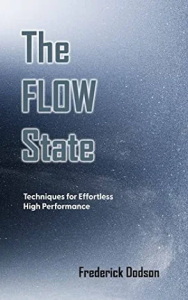
‘The Flow State’ by Frederick Dobson
How much of your average day do you spend ‘in a flow state’?
I have been immersed in understanding the ‘flow state’ for over 20 years now and I teach the flow state in 3 fields: Personal flow, leadership flow and business flow.
 I have found no one book on the subject of flow that covers all the elements that I have uncovered in my 20 years of practical application with individuals, with leaders and with business structures.
For this reason I am about to launch a free video series called ‘Creating Your Flow’ which you will be able to find on my YouTube channel “Creating Your Flow’ and my LinkedIn posts https://www.linkedin.com/in/certainprogress
Every time I have read a book about ‘the flow state’ it has given my insights and ideas which I have tried out myself and then with hundreds of clients over 20 years.
The first book I think about is “Man’s Search for Meaning” by Victor Frankl, about his experience of living for over 4 years as a prisoner in a Nazi concentration camp. Instead of using the word ‘flow’ Frankl uses the word ‘fulfilment’ equating it to many of the concepts that other authors equate to ‘the flow state’.
Frankl recognises the universally accept concept that states of fulfilment / flow states are entered where 1- ‘You have a clear outcome’ and 2- ‘You are doing something you enjoy’
However Frankl sets himself apart from the author of this book and the author of the best-selling book simply called ‘Flow’ by Professor Mihaly Csikszentmihalyi, by adding ‘suffering’ as another experience by which you MAY enter a flow state, and being a professional Psychologist living in a concentration camp Frankl was well placed to understand this.
I believe that inspiration is a balanced state that can include suffering balance with greater purpose.
I have found the inclusion of ‘suffering’ within ‘flow states’ to be true in my 20 years of working in this field, however achieving a flow state whilst suffering is more challenging and requires a shift in consciousness. It is NOT covered by any other authors I have come across in the field of flow and this is something I will be covering in detail in my upcoming free video series ‘Creating Your Flow’.
That aside, let’s now focus on traditionally recognised flow states which are amazing states that most people spend very little time in, yet they are the most fulfilling, rewarding and productive experiences.
Back in November 2018 my Book of The Month review was ‘Flow’ by Mihaly Csikszentmihalyi, the book that put this subject on the map (you can read that review here). Dodson reaches the same destination by a very different road. Csikszentmihalyi turns up with a lab coat and a clipboard. Dodson turns up with a tennis racket and a request that you stop trying so hard. Reading them back-to-back as I did last month, proved far more useful than reading either one alone.
What is the book actually about?
The stories come from Dodson’s tennis and from the several businesses he runs, and around them he wraps techniques and exercises you can try for yourself.
The twist is where he puts the weight. His earlier books pushed conscious creation: set the intention, direct the mind, make it happen. This one pushes the reverse. Surrender and release, and let the subconscious carry most of the load. For an author whose name was built on the first instruction, that is a bold turn, and I respect him for making it.
He also describes flow in more colourful language than Csikszentmihalyi ever used. Reality turns fluid, the surroundings register as energy or vibration, and time slows while space stretches. I read that as one man’s report of his own experience, not a claim about physics. Athletes and musicians often reach for similar language when they try to describe their best moments.
The central idea is that flow visits the humble and the present, and avoids anyone trying to master or control it. It grows out of silence. The ideal state for it is what Dodson calls ‘soft focus’: fairly neutral, low on strong emotion, high on awareness and light on effort. Difficult circumstances can even help, because they demand deeper focus.
A word on ‘surrender’, because it is easy to misread. Dodson’s tennis stories only make sense if the player has already put in the work. Surrender is the second half of a two-part move: prepare, then release. Skip the first half and what you call surrender is really drifting. That is my interpretation, and it is the version I would teach.
Here is a picture that helps. Csikszentmihalyi is the sailor who trims the sails to match the wind and adjusts challenge against skill until the boat sings. Dodson is the same sailor at the instant he lets go of the tiller and the boat finds its own line. Both are sailing. Only the second involves trust.
Where the two books agree
In my 2018 review I listed Csikszentmihalyi’s eight components of flow. Several of them turn up in Dodson’s account, wearing different clothes. Dodson points out that flow is hard to describe because the person doing the describing disappears. That is the ego stepping aside, which is Csikszentmihalyi’s seventh component. Time warps in both books, shrinking in one and stretching in the other. Emotional charge drops in both: everyday worries vanish for Csikszentmihalyi, while Dodson’s soft focus sits in a neutral state.
The deeper agreement sits underneath the techniques. Csikszentmihalyi’s ‘autotelic’ people put their attention on what matters most to them, and the result looks like inexhaustible energy. After years of studying Axiology (the study of values) under Dr John Demartini, I read that as people living in close alignment with their highest values. Dodson’s surrender runs on the same fuel. Let go into a task your values care about and flow has somewhere to land. Let go into one they don’t and you get wandering. Forty minutes of ‘relaxing into it’ on a spreadsheet you resent produces a nap, not a breakthrough.
Where they collide
Csikszentmihalyi’s fourth component is laser beam focus. Dodson’s ideal is soft focus. On the page those look like a contradiction. My reading is that they describe one state from two sides. Laser beam is what flow looks like from the outside: nothing gets in. Soft focus is what it feels like from the inside: no gripping, no straining, awareness wide open. A concert pianist looks like pure concentration from the third row. From the stool it feels like listening.
The sharper collision is over skill. Csikszentmihalyi found flow at the upper edge of the abilities you already have. Push the challenge past that edge and you get anxiety; let it fall below and you get boredom. Dodson’s tennis comebacks make gripping reading (one reader’s summary describes a set rescued from 0-4 down), yet a gripping story is not a controlled study. The idea some readers take away, that flow can stand in for instruction, is contested, and the research points the other way. A beginner who sits behind the wheel for the first time and trusts the flow gets a crash, not a lesson. The player who wins from 0-4 down is drawing on thousands of hours of practice. Flow released what was already there.
This links back to my September review of ‘A New Earth’ by Eckhart Tolle. Egos want to control outcomes and keep score. Dodson’s request that you arrive humble and without demands is, in practice, a request to put the ego down for an hour. Easier said than done. Awareness of the grip comes first, which is Tolle’s whole point.
Why leaders should care
Flow has a structural enemy, and it sits in your calendar. A diary packed with thirty-minute meetings, a phone buzzing on the desk and an inbox open in the next tab make unbroken concentration close to impossible. Csikszentmihalyi’s conditions need time to build, and Dodson’s silence needs a door that closes. If you lead a team, the practical step is to protect stretches of uninterrupted work, for yourself first and then for the people who report to you. Few changes cost less. I would rather see a team produce four hours of absorbed work than eight hours of fragments.
Who will love it, and who won’t
Readers are split, and sharply. One listener says it cured their writer’s block and praises the simple exercises. Another calls it the worst book on the topic they have read and complains of unsubstantiated statements presented as fact. A third warns that it bears no resemblance to ‘Peak’, which is rooted in science and psychology.
I think all three are right. If you want research, read Csikszentmihalyi, or ‘Peak’ by Anders Ericsson. If you want a practitioner’s notebook of things to try on Monday morning, Dodson delivers. Here is the harsh reality: a self-published book of personal experience cannot settle anything about how consciousness works, and where Dodson states his experiences as facts about reality, the evidence isn’t there. Here is the optimistic reality: an experiment costs you ten minutes, and you are the lab.
What I would change
Three things. First, a short chapter on matching challenge to skill would close the biggest gap in the book, because surrender works far better when the task sits at the edge of your ability. Second, a clearer line between ‘here is what I experienced’ and ‘here is how reality works’ would protect Dodson’s best material from his weakest claims. Third, references. A reader who wants to follow the thread into the research should find a trail to follow.
A flow routine you can try this week
I have blended both authors into one sequence. The order matters, so a numbered list earns its place here.
- Pick the work that matters most. Choose the task closest to your highest values and your Greater Purpose. If you cannot say why it matters, flow has no reason to visit.
- Set the difficulty dial. Aim for a task that stretches you just beyond comfortable. Bored? Add a deadline or a harder standard. Anxious? Shrink the task to a piece you can win. Dodson makes a fair point that difficult circumstances can sharpen focus, so shrink the piece, not the ambition.
- Buy yourself silence. Put your phone in another room, close the inbox and sit still for two minutes before you start. Dodson says flow grows out of silence, and ten minutes of quiet is a modest price for an hour of focus.
- Soften the focus. Drop your shoulders, unclench your jaw, let your gaze widen and slow your breathing. If you catch yourself gripping the pen or hunching toward the screen, that is effort, and effort is what you release.
- Name the next step, then drop the outcome. Csikszentmihalyi asks for a clear goal and immediate feedback, so write one sentence naming the very next action. Dodson asks you to arrive without demands, so stop checking whether flow has turned up. A watched kettle never boils, and a watched flow state doesn’t arrive either.
- Rest on purpose afterwards. As I noted in my 2018 review, you must spend time out of flow to experience it, so it can never be a permanent state. Take a walk. Eat a proper lunch. Recovery belongs to the process.
Here is how it looks on a real task. Say you have a proposal to write. You choose it because winning that client matters to your purpose. You trim the scope to the opening section so the challenge sits just above comfortably. The phone goes in a drawer, the door closes, and you sit in stillness for two minutes. Your shoulders drop. You write ‘draft the first three paragraphs’ on a sticky note and start, without peeking at the clock. Forty minutes later you look up and the section is done. Then you walk round the block.
Run the routine for a week and keep a one-line log after each session: the task you did, and whether time went missing. Patterns appear quickly. Many people find flow lives in one or two kinds of task, and the log shows which.
Here is the biggest takeaway….
Flow is what fulfilling, purposeful action feels like from the inside. Treat it as a productivity trick and it slips away. One of our core values at Certain Progress is that greater success and profits are a by-product of fulfilling, purposeful actions, and these two books explain that statement from opposite ends. Csikszentmihalyi gives you the conditions: clear goals and immediate feedback, with challenge matched to skill. Dodson gives you the attitude: stop gripping.
Read Dodson as a field guide of experiments and Csikszentmihalyi as the map. Test each technique, keep your own scorecard and discard what doesn’t work for you. That is what a student of applied wisdom does.
The whole concept of flow is a profound subject, flow can only ‘be experienced and felt’ it can not be ‘known’ in the way you might know something from reading a book, therefore if being in flow more often is important to you I would recommend this book together others I have mentioned in this review and of course I would also recommend that you register for my upcoming free video series ‘Creating Your Flow’. (You can email ‘Flow’ or message the word ‘Flow’ to me on LinkedIn and I will place you on my early registration list).