
‘Tell The F*cking Truth’
by Craig White
Book of the Month November 2026
There is always a sense of pride when one of your former clients goes on to write an epic book such as this one.
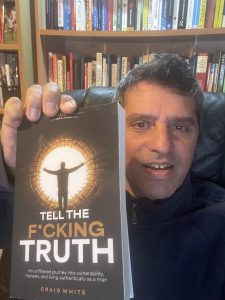 For my small part, I did some major purpose, vision and values work with Craig back in 2018. I met him at a Breakthrough Experience event that year, where I was assisting my mentor, Dr John Demartini, as a facilitator. These are fully immersive events where we help people to dissolve and overcome the deepest, darkest emotional charges holding them back from fulfilling their potential. So, it is no surprise that Craig attends such events, a man like myself who has an insatiable appetite to further understand and experience the transformation of human potential and the human spirit. Craig has spent most of his life pushing himself to grow physically, mentally, emotionally and spiritually and to coach and mentor others to do the same. It is fitting that Craig has gone on to produce such a wonderful book about this very subject.
When I first read the book’s title ‘Tell The F*cking Truth’, knowing Craig as I do, what it immediately meant to me was ‘Authenticity!’. Being authentic, and knowing who you truly are, is at the heart and soul of Craig’s mission and his work as a mentor and coach. For 30 years Craig has coached high achieving men in sport who, as a bi-product of their ambitions to achieve, have often brushed under the carpet many mental and emotional blockages and unresolved traumas.
Craig is one of the top performance coaches in world rugby and has worked with some of the greatest players, coaches and national teams in the sport. His journey as an elite performance coach led him to look deep into his own soul, and that is what this book is about.
The foreword is by one of England’s most accomplished rugby players, James Haskell, who sets the scene wonderfully well by explaining his own journey as a very successful, performance-driven athlete, and then his journey of personal discovery and leadership. He realised that he needed to look in the mirror and face his own demons, the ones that most people, looking on, would not realise he had. Haskell’s heartfelt words convey how much of a key figure Craig was in his life in facing his demons and facing the truth of who he was.
I love the fact that Craig opens the book with a chapter called ‘The Messy Middle’, because it is key to him not to put himself above others, or below them, which I think is critical for any great mentor, guide or coach. By starting the book this way, he tells us that he is still on his own journey and that even in writing this book he has experienced even more of his own personal breakthroughs. He explains that the book is not just about the journey of the people he has helped but also his own, overcoming the challenge of not being as emotionally open as he could be as a man. Those wounds are very apparent in the tribute he pays to his own father at the beginning of the book.
What I admire about Craig’s approach is his recognition that we all have so much to learn. No matter where we are on our journey up our own personal mountain, there is still plenty of mountain to go. I believe it is never-ending. There is always something more to learn, something to uncover, something to discover about yourself, and Craig does not present himself as some kind of guru. That, I believe, is what makes him the outstanding coach, leader and human that he is.
Back then, when Craig was a client of mine and was not coaching some of the top players and coaches in rugby, he ran a workshop called ‘Men Without Masks’. It is not just high-performing men who wear masks; it is all men in society. As Craig explains, there is the alpha male mask, the joker mask, the stoic mask, the self-sufficient mask, the high achiever mask, the nice guy agreeable mask, the workaholic mask (whose diary is always full and whose life is always deferred), the aloof leader mask (the lone wolf), the ‘I have got everything under control’ mask, and so on. Craig has met them all and has worked with them all at a very deep mental, emotional and spiritual level. If you know someone like that, whether yourself or someone else, this book could be for you: a book about confronting the deeper truth of who you are.
I must disclose that I may be a little biased in writing this review for two reasons. Firstly, Craig is a friend of mine (and a client), and secondly, I am a big fan of rugby. But joking aside, it is simply a phenomenal book about personal growth and becoming a greater leader.
The book is brutal about the level of honesty and self-reflection required to navigate the challenging journey of becoming a more self-aware, more emotionally intelligent and ultimately more fulfilled man. So, if you want to face the fear of really looking at yourself in the mirror, then this is probably the book for you. If you do not want to face yourself in the mirror, then at least read this book to know what you are turning down.
Of course, facing challenges in life is a continuing cycle, but when you do it from a place of greater authenticity and integrity, you feel more fulfilled in life, more at ease in your own company, more connected in relationships and generally more joyous in your outlook.
I love the structure of this book, which starts with the foreword by James Haskell, then the author’s introduction, which he calls ‘The Messy Middle’, followed by three parts. Part One is The Wound, Part Two is The Work and Part Three is The Integration. Each part consists of a number of chapters. At the end of each chapter, Craig provides an exercise, which usually involves reflecting on something. For example, at the end of Chapter 1, ‘The Wake-Up Call’, Craig tells us to sit still without a phone or a task, not to meditate but just to notice what we are feeling in our bodies and what we are trying not to feel. He recommends that you journal your experience, and he says that five minutes of honesty is harder than it sounds. He then quotes a paragraph which he calls ‘the truth for Chapter 1’: children do not need a perfect father; they need a man who tells the truth, faces his shit, keeps showing up and stays emotionally connected.
I have already mentioned that I love the structure of the book and Craig credits this to a lady called Tracey Duke (https://www.linkedin.com/in/tracey-duke/) who helps people to write books and she comes highly recommended. The book’s structure makes it really easy to understand Craig’s philosophy and his approach to his coaching and mentoring as per the following outline summary:
Part One: The Wound
The Wake-Up Call
Every transformation has one: the moment the performance stops working. It rarely looks dramatic from the outside.
Practical tip: Craig’s own exercise, described above, is the starting point. Build on it by writing your own wake-up call in 200 words. What happened, what did you feel, and what did you do next? If the answer is ‘worked harder’, you have found your pattern.
The Wounded Leader
Old hurts walk into boardrooms and team meetings with us, dressed as strategy. Leaders who have not met their wounds end up managing around them.
Practical tip: Before your next difficult meeting, ask: ‘Which old hurt could be steering me right now?’ Notice where it lives in your body, then choose your response rather than inheriting it.
We Can’t Be What We Can’t See
Most of us copied what we watched. If the men around you never modelled honest emotion, you had no template to follow.
Practical tip: Write down what the men in your early life showed you about feelings. Then name one man today whose honesty you admire, and pick one of his behaviours to borrow this month.
I’m Not Enough
The oldest story, and the most expensive. It drives overwork, people-pleasing and a good deal of unnecessary spending.
Practical tip: For one week, log every ‘not enough’ thought, then ask for the evidence. Separate fact from story. Measure yourself against your own highest values rather than someone else’s scoreboard.
A Society of Nice Guys
Niceness can be a mask. Agreeing is cheap in the short term and ruinous in the long term, because nobody ever meets the real you.
Practical tip: Spot one ‘yes’ this week that came from fear. Practise an honest, kind ‘no’ in its place, and notice that the relationship survives.
Triggers & Lies
Most triggers are old stories wearing new faces, and the lie is usually the story we tell about what just happened.
Practical tip: When you are triggered, pause. Name the feeling in one word. Then ask: ‘What story am I telling myself, and is it true?’ Only respond once you have an answer.
Part Two: The Work
Men & the Sexual Shadow
This is the subject many men are least willing to discuss, which is exactly why it earns a chapter. Shame grows in silence.
Practical tip: Choose one thing about your sexuality that you have never said aloud, and say it to a safe, confidential person such as a skilled coach or therapist. If trauma is involved, work with a qualified professional.
It Starts With You
Change begins with ownership. Our value of Total Ownership of Challenges applies directly: we are students of applied wisdom, not victims of circumstance.
Practical tip: Take a five-minute check-in each morning: what am I feeling, where is it in my body, and what do I need today? Write one line.
Relational Presence
Presence is the gift most successful people cannot give, because their attention is always on the next problem.
Practical tip: Give someone you love ten minutes a day with your phone in another room. Ask one open question and listen without fixing. Fixing is a very good way to avoid feeling.
Reclaiming Emotional Safety
People tell the truth when it is safe to do so. That is Confidential Empowered Relationships in plain terms: a safe space for free and authentic expression.
Practical tip: Agree one rule with your partner or team: nobody is punished for telling the truth. When someone does, your first words are ‘Thank you for telling me.’
Real Men Cry
The title is a provocation, and a fair one. Suppressed emotion does not vanish. It leaks out as irritability, illness or distance.
Practical tip: Next time your eyes fill, stay with the feeling for a minute rather than swallowing it. Practise alone first, perhaps with a piece of music that moves you, then with one trusted person.
Men Need Men
Isolation is the silent partner of the performing life. Men who have a few honest friends carry less alone.
Practical tip: Form or join a small men’s group. Agree confidentiality at the start, meet on a fixed schedule and adopt one rule: no advice unless asked.
Men Need Women
The title can sound like a cliché, but it points to something real: we learn about ourselves from people whose experience differs from ours.
Practical tip: Ask a woman you trust: ‘What is it like to be on the other side of me?’ Listen without defending, and say thank you.
Part Three: The Integration
Building Trust
Trust is not declared. It accumulates through small promises kept.
Practical tip: Make one tiny commitment each day and keep it. When you cannot, say so early, before the other person has to find out.
Redefining Power
Many of us inherited a definition of power as control, volume or status. It is worth asking who taught you that.
Practical tip: Write your current definition of power and who handed it to you. Then test a new one: the ability to stay present and honest under pressure. Apply it to one decision this week by asking before telling.
Embracing Spirituality
Craig’s collaborator notes his openness about keeping books on Buddhism and visiting Krishnamurti centres while building a career in high performance. Practical and spiritually connected, with no esoteric language, is a balance I try to hold myself.
Practical tip: Take ten minutes of stillness each morning before you touch your phone. The aim is to hear what is true, which is different from feeling calm.
Why This Work Matters
Purpose is the fuel. Our own core idea is that success and profit follow fulfilling, purposeful action, and the same holds for inner work.
Practical tip: Write down who benefits if you do this work. Choose one person and tell them what you are committing to. A promise made aloud is harder to drop.
Where I would push back
First, the masculinity frame. Truth-telling is a human skill, and ‘the authentic man’ can itself become a costume. Tolle warns that identity attaches to anything, including ‘awakened’ roles. If you finish this book proud of your new status as the honest man in the room, you have swapped masks.
Second, a book this new has had little time to meet critical readers. Praise so far comes largely from Craig’s own world, so treat early reviews as a starting point. He also runs mentoring programmes, which is normal for an independent author but worth knowing.
Third, the title can be heard as a licence for bluntness. Truth without care injures. Our value of Critical Compassionate Thinking applies: challenge and compassion in balance. Start with the truth you tell yourself, then ask how to say it so the other person can hear it.
How to use it
Read with a pen. Take one chapter at a sitting and try its tip for a week before you move on. Stop when something stings, because the sting is information. If you have a trusted friend, read it together and compare notes.
Here is the biggest takeaway….
Authenticity equates to an inward act of being truthful about yourself with yourself. Before you tell anyone else the f*cking truth, you have to stop lying to yourself about what you feel and what you value. As in my work with leaders, awareness and authentic self-reflection are the essential keys to unlocking your potential to live your most fulfilled life.
To find out more about Craig and his work you can visit his website: https://craigwhitementoring.com/
If you are a budding author yourself, to find out more about the lady who helped Craig with the structure and process to write a great book, you can check out her on LinkedIn … https://www.linkedin.com/in/tracey-duke/