
The Experience Machine
By Andy Clark
I have not previously encountered a book that addresses and explains the fundamental function of our ‘predictive brains’, a function that determines both how we each perceive and experience our individual realities!
Recommended by Rory Sutherland
In my quest to help thought leaders become greater thought leaders, I endeavour to help them become greater thinkers. In turn, I ensure that I am learning from the greatest thought leaders I can find, people like Rory Sutherland!
When Rory Sutherland recommends a book, as he did this one, it almost by default becomes compulsory reading for me and the purpose-driven entrepreneurial business leaders I work with.Rory is one of the greatest minds and thought leaders in the field of understanding human behaviour and how we perceive reality in life, and particularly in business (check out his videos on YouTube).
“Your brain is not a camera. It’s a prediction engine.” Andy Clark
In the book, the author, Andy Clark, provides a series of images (available as a PDF) and sounds (available within the audiobook or on a separate link) that illustrate that our perception of reality is often different to a more objective version of reality, one our predictive brain prevents us from recognising, or causes us to misread, like a mirage or an illusion.
Look at the image below, the Kanizsa triangle illustration: there is only one triangle drawn out in this image…

… yet our “predictive brain” gives us the perception that there are two fully drawn triangles. These spatially separate fragments give the impression of illusory contours (also known as modal completion) of a triangle.
If you only take away one key insight from this book, it should be this:
“Our perception of reality can vary greatly in its objectivity, yet it is this perception that drives our understanding of reality and our subsequent behaviours!”
When I worked as an NLP Trainer (Neuro Linguistic Programming) in the Tony Robbins environment for five years, I learned a lot of insightful tools and techniques not generally taught in schools and universities. I witnessed these NLP tools help people resolve disempowering thought patterns and behaviours, like overcoming a phobia or anxiety, stopping smoking, or resolving a relationship conflict.
The powerful results I witnessed and helped people achieve spoke for themselves. For me, though, something was missing: a robust underlying neurological framework and philosophy, beyond simply recognising the profound power of the unconscious mind. According to the NLP Communication Model, your conscious mind can only process 7 to 60 bits of information a second, whereas your unconscious mind can process an astonishing 1 million up to 1 billion bits of information a second!
For me, The Experience Machine provides much of the missing robust underlying neurological framework and philosophy that explains not only why so many NLP tools work, but far beyond NLP, how human perception works more broadly, and how that perception ultimately drives all human behaviour.
‘What is reality?’ and ‘What is your perception of reality?’
Have you ever stopped to ask yourself a genuinely strange question: is what you’re seeing, hearing, and feeling right now actually “reality,” or is your brain constructing something else entirely, and simply calling it reality? For most of us, the answer feels obvious. Of course my eyes show me what’s really there. Of course my senses are giving me the world as it is.
The author, Andy Clark, is one of the world’s leading cognitive philosophers, who spends this entire book dismantling that assumption , and by the end, you’ll never look at your own mind, or your own business, in quite the same way again.
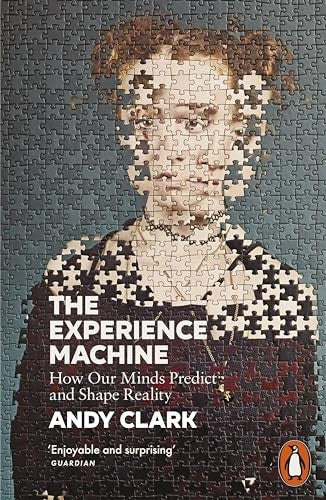
The central premise of The Experience Machine is what’s known in neuroscience circles as “predictive processing.” For decades, we assumed the brain worked a bit like a camera or a microphone, passively recording sensory data from the outside world and reporting it back to us as “experience.” Clark shows, drawing on a huge and growing body of neuroscience, that this picture is almost backwards.
Instead, your brain is constantly generating predictions about what it expects to sense next, based on everything it has learned so far. What you experience , what you see, hear, feel, even how much pain you’re in ,is the result of those predictions being tested, refined, and blended with the raw sensory signals coming in. Ina very real sense, perception itself is what Clark calls a “controlled hallucination”: not a fantasy disconnected from the world, but a live, ongoing best-guess construction, built jointly by your mind and your surroundings.
This is not some abstract philosophical parlour trick. As I read through the book, I found myself constantly relating it back to my own life, my clients, and the businesses I work with every day.
When prediction goes wrong: pain, anxiety, and stuck patterns
One of the most powerful sections of the book explores what happens when this predictive machinery misfires. Clark explains how conditions like chronic pain and anxiety can, in many cases, be understood not asa simple signal of damage or danger in the body, but as the brain’s prediction system getting “stuck” ,continuing to forecast pain or threat long after the original cause has resolved, and then generating the felt experience to match that expectation.
I found this section genuinely eye-opening. It reframes chronic pain and anxiety not as purely mechanical problems to be masked with medication, but as patterns of expectation that, in many documented cases, can be gradually retrained. Clark is careful and evidence-based throughout , this isn’t wishful thinking dressed upas neuroscience , but the implications are still profound.
If so much of our felt experience is generated by prediction rather than simply “reported” from the world, then changing our patterns of expectation can genuinely change our lived reality.
As someone who has spent years helping entrepreneurs work through limiting beliefs, self-doubt, and stress, this understanding of what shapes our perception links strongly to all our belief systems.
Much of what we experience as leaders , the anxiety before a big pitch, the tension we carry into a difficult conversation, even our sense of what’s “possible” for our business , is being generated by predictions we’ve built up over years, rather than by what’s objectively true right now.
The Placebo Effect
The power of the predictive function of our brain is found within the placebo effect, which I have covered extensively in two books I have previously reviewed: The Biology of Belief by Dr Bruce Lipton and You Are thePlacebo by Dr Joe Dispenza.
Examples given are where someone taking a sugar pill, believing it to be a headache pill, experiences a reduction in their headache because their predictive brain triggers the belief and the neurological expectation that the headache will be reduced by the pill.
The dissolving boundary between you, your body, and your world
Clark , who, alongside philosopher David Chalmers, originally developed the influential “extended mind” theory, takes this even further in the book’s later chapters. He argues that the sharp boundary we assume exists between “me” (my mind) and “not-me” (my body, my tools, my environment) is far blurrier than we think.
Our thinking and experience are deeply entangled with our bodies and the tools and environments we use, to the point that a notebook, a spreadsheet, or a trusted colleague can genuinely function as an extension of our own cognitive process, not just a helpful accessory to it.
Physiology is fundamental!
On reading this, something Tony Robbins drilled into me for years made even more sense. He said:
“The reality we create is driven by our language, our physiology and our focus!”
Andy Clark’s recognition of the role of our body explains why our physiology has such a huge role in our perceptions, our mood, and our behaviours.
I recall working with a telephone sales organisation about 12 years ago, when I suggested that , when and only when the salespeople were actually speaking with a customer or potential customer , they should stand up until the conversation was finished. The results were spectacular: with no other changes at all to their pitch, approach, or offer, they created a 12 percent increase in sales volumes over the next 6 months!
For entrepreneurial leaders, I think this is one of the most quietly radical ideas in the whole book. We tend to think of ourselves as the sole engine of our decisions and our creativity, operating inside our own skulls. Clark makes a compelling case that our best thinking has always been a partnership between our brain’s predictions, our bodies, our environment, and the people and tools around us.
Key takeaways for purpose-driven entrepreneurial leaders
Here are the insights from this book I believe are most valuable for the leaders and entrepreneurs I work with:
- Your team’s “reality” at work is a prediction, not a fact. Every person on your team is quite literally constructing their experience of your business’s culture, values, and leadership based on their brain’s predictions , shaped by past experience, expectation, and trust. Change the inputs (clarity, consistency, communication) and you genuinely change what your people experience, not just what they’re told.
- Stress and self-doubt are patterns, not verdicts. If chronic pain and anxiety can be understood as the brain repeating an outdated prediction, the same is almost certainly true of the self-doubt and stress so many leaders carry. It’s worth asking: is this feeling responding to what’s actually happening right now, or to an old prediction my mind hasn’t updated?
- Your environment is part of your cognition, so design it deliberately. Since Clark shows our thinking is genuinely extended into our tools, notes, and surroundings, it follows that a cluttered inbox, a chaotic workspace, or a disorganised business genuinely degrades your thinking , it isn’t just an inconvenience alongside it. Leaders serious about clarity of mind should treat their systems and environment as part of their cognitive toolkit, not separate from it.
- Expectation shapes performance, for you and your people. If perception and experience are built from prediction, then the expectations you hold for your business, your team, and yourself are not passive forecasts , they are actively shaping the reality you and others go on to experience. This is close to what many great leaders have intuitively understood for years, but here it’s grounded in genuine neuroscience.
- Uncertainty is where growth happens. Clark’s model shows that the brain grows and adapts precisely when its predictions are challenged by new information , what’s called “prediction error.” Businesses (and people) that insulate themselves entirely from surprise, challenge, and new information stop updating and stop growing. As uncomfortable as it is, the moments when your assumptions about your business get proven wrong are exactly the moments your model of reality , and your business , gets better.
A book that rewards a slow read
This is a more academically dense read than many of the books I recommend; however, it delivers practical lessons that can transform how you and others perceive and respond to reality. Clark is a professional philosopher of mind, and parts of the book require your full attention rather than a casual skim. But the payoff is absolutely worth the effort. Unlike many popular science books that offer one interesting idea stretched thin across 300 pages, The Experience Machine keeps delivering genuinely new implications right through to its final chapters , for mental health, for how we think about ourselves, and for how we build and lead in the world.
If you’re a leader who has ever wondered why changing your mindset seems to change your results, or why the stories you tell yourself about your business seem to become self-fulfilling, this book will give you the underlying science behind what you’ve probably already sensed intuitively.
I highly recommend this book to any leader serious about understanding not just how their business and the wider world works, but how their own mind constructs the reality they’re leading from.
Finally, I will leave you with a quote of my own to reflect on, gleaned from 20 years of mentoring and coaching in the Thought Leadership space:
“When you expand your conscious awareness of reality, you expand your subjective understanding of your perceptions and you expand your mastery of your reality!”
References & Further Reading
- Andy Clark , Professor of Cognitive Philosophy, University of Sussex: profiles.sussex.ac.uk/p493-andy-clark
- The Experience Machine , publisher page (Penguin Random House):penguinrandomhouse.com/books/608016
- Rory Sutherland , Wikipedia overview: en.wikipedia.org/wiki/Rory_Sutherland | YouTube:youtube.com/@RorySutherland-UK
- Extended Mind theory (Clark & Chalmers): en.wikipedia.org/wiki/Extended_mind_thesis
- Kanizsa triangle / illusory contours: en.wikipedia.org/wiki/Illusory_contour
- Placebo effect: en.wikipedia.org/wiki/Placebo
- The Biology of Belief by Dr Bruce Lipton
- You Are the Placebo by Dr Joe Dispenza
- NLP Communication Model , overview: en.wikipedia.org/wiki/Neuro-linguistic_programming