
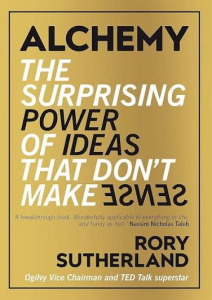
‘Alchemy’
“The Surprising Power of Ideas That Don’t Make Sense.”
By Rory Sutherland
“A flower is simply a weed with an advertising budget!” This quote from Rory Sutherland as a metaphor for business is as brilliant as it is funny! If you are not familiar with the eccentric, charming, witty and profound insights of Rory Sutherland you are in for a treat with this book.
If there is a greater business thought leader in the ‘purposeful creativity space’ than Rory Sutherland I have not yet encountered them! Over the years Rory Sutherland’s insights have served me and in turn my clients to creatively think and develop their businesses in ways that are both ‘left-field’ and astonishingly powerful.
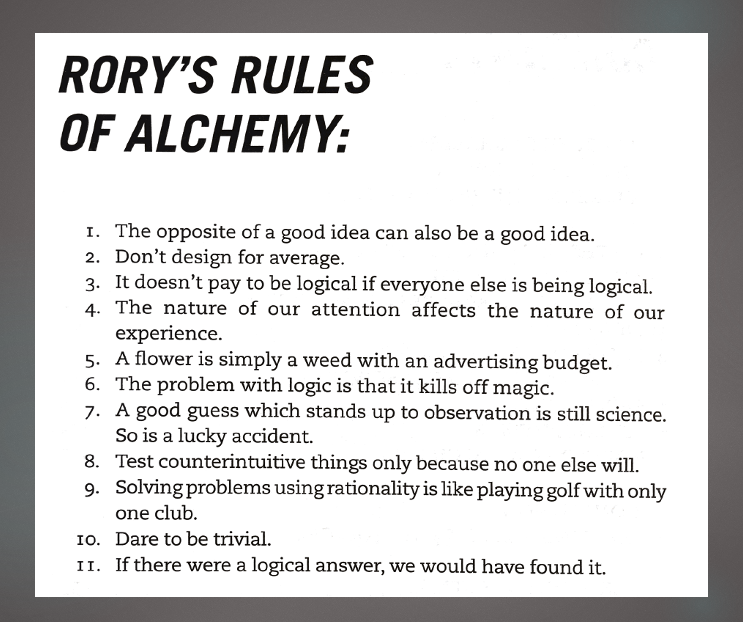
“The opposite of a good idea can also be a good idea.”
Rory Sutherland
Some years ago, inspired by Rory Sutherland, when I worked with an insurance agency, they initially thought that it was probably NOT a good idea for insurance sales agents to send a box of freshly baked cake to new and renewing clients, after all, what business does an insurance agency have distributing cakes?
Of course, they partnered with a cake business to do this and by doing so, they dramatically reduced cancellation rates (during the cooling off period) they significantly increased policy renewals and they also nearly doubled the percentage of personal referrals!
The cost of the cake was a tiny fraction of the returns to the business.
 This book is so aligned with a big part of the work I do helping business leaders to develop a mindset that operates from a higher level of both purposeful service and creativity in order to both solve great challenges and to identify and exploit great opportunities that others often do not see and / or do not know how to exploit.
If you have followed any of my previous reviews, you will know that when Rory Sutherland speaks, I listen. He recommended ‘The Experience Machine’ by Andy Clark, a book I reviewed last month, and it profoundly changed how I think about perception and reality. So, it felt only right that I finally sat down and reviewed Rory’s own book, ‘Alchemy’.
Rory is the Vice Chairman of Ogilvy, one of the world’s oldest and most respected advertising agencies, it’s founder David Oglivy is in my opinion one of the greatest geniuses to ever work in the field of advertising and marketing.
For decades Rory has been one of the most insightful and entertaining voices working at the intersection of psychology, marketing and human behaviour. If you have never watched one of his TED talks, please stop reading this review right now and go and watch one. Then come back.
If you only take away one insight from this book, let it be this:
“Logic is not enough. Some problems are not solved by more reasoning, but by more magic.”
What is alchemy, really?
The central premise of the book is deceptively simple. We live in a world obsessed with logic, data and reason. Every business decision we make is expected to be justified through spreadsheets, A/B split tests and rational argument. Rory argues, convincingly, that this obsession with narrow logic has blinded us to an entire universe of solutions that are not rational at all, yet work brilliantly.
He calls these solutions ‘alchemy’. Not because they involve any actual magic, but because, much like the alchemists of old who transformed base metals into gold, these ideas transform the value of something without changing its physical properties at all. The value is created entirely in the mind of the person experiencing it.
As someone who spent five years as an NLP Trainer in the Tony Robbins environment and has helped 100s of entrepreneurs to enhance how they market and sell their products and services, this idea landed powerfully for me.
So much of what I taught and witnessed in that world was about changing someone’s perception of an experience, not the experience itself. Rory’s book gave me an entirely new business framework for understanding why that mattered so much, not just in personal transformation, but in commerce, marketing and leadership.
The Eurostar example AND ‘HS2’
One story from the book that has stayed with me for years is Rory’s account of the early days of Eurostar. Engineers were asked how to improve the journey from London to Paris. Their answer, entirely logical, was to spend a huge sum of money building faster tracks to shave time off the journey.
Rory’s alternative suggestion was radically different, and radically cheaper. Instead of making the train faster, why not spend a fraction of that money making the journey more enjoyable? Hire supermodels to walk up and down the train handing out free glasses of Chateau Petrus for the entire duration of the trip. Passengers would arrive so satisfied that they would want the journey to last longer, not shorter.
Nobody chose that solution, of course. But it beautifully illustrates his point. The engineers were solving for time. Rory was solving for the human experience of time, which is an entirely different problem, and often a far cheaper one to solve.
HS2 – The Greater Purpose should be ‘the customer experience’, not the logical performance ‘faster train’ metrics that 99.0 percent of people focus on!
What is true for Eurostar is also totally true for the £100 Billion ‘fiasco’ known as ‘HS2’!
If you are not already aware, High Speed 2 (HS2) is a major, under-construction high-speed railway project in England designed to increase rail capacity and improve connectivity between the north and the south of the country. As of March 2026, the UK government has already spent £44.2 billion on the programme. The total expected cost to complete the now-shortened railway is estimated to be between £87.7 billion and £102.7 billion.
The mainstream headlines about the HS2 high speed trainline and carriages are two-fold, firstly that HS2 will save around 30 to 36 minutes on a journey between London and Birmingham, and secondly the extraordinary high cost that will most likely exceed £100 Billion!
The assumed logical but false ‘greater purpose’ of HS2 is to ‘save time’, as illustrated by the above Eurostar train example cited by Rory Sutherland who also makes parallel references about HS2.
Saving 30 plus minutes is a narrow-minded metric that politicians and engineers they hired focused on … as if ‘shortening the journey time’ is the greater purpose of the project… not to mention the disproportionately high taxpayer funded expenditure. The leaders of the HS2 project have completely missed the true greater purpose that their customers truly want which from a customer mindset perspective should be to provide a ‘great journey experience’, regardless of the time!
No one involved in spending £100 Billion of taxpayer’s money for HS2 raised their hands and said ‘Hold on everyone, let’s think this through, what about if we made the customer’s travel experience so enjoyable that they looked forward to their journey time on the train and were even happy for it to last for longer?’
For a tiny fraction of £100 Billion, comfortable luxury carriages could have been constructed with super high speed reliable internet, where a selected number of the carriages are ‘quiet carriages with desk spaces where people commuting can have some really valuable undistracted quiet time to plough through emails and projects and other such tasks that are more challenging to do once they are in an office or home environment with other distractions. People traveling on holiday with friends and family could travel on socially friendly carriages with larger communal tables and extra children’s facilities.
There could even be facilities to people who wanted to watch movies.
Typical of what I find in so many businesses that are failing to deliver great value to their customers, because they are ignoring the psychology of customer experience, the leaders of HS2 completely lost sight of the greater purposes which is to give the customer a great experience at a reasonable cost to the taxpayer; instead, they fell in to the trap of assuming that it is all about the key performance metric of ‘the train travelling quicker’! Which is just ‘a KPI’ (a key performance indicator and NOT the customer’s or taxpayer’s greater purpose.
Psycho logic versus logic
Rory introduces a concept in the book he calls ‘psycho logic’, a form of reasoning that works brilliantly on human beings, even though it makes no sense under conventional logic.
A wonderful example he gives is the story of a hotel that received complaints about slow lifts. The engineers were called in to make the lifts faster, at enormous cost. Instead, someone had the idea of installing mirrors next to the lift doors. Complaints stopped almost entirely. People became so absorbed in checking their own appearance that the wait no longer felt long at all.
Nothing about the actual speed of the lift changed. What changed was the subjective experience of waiting. This, for me, is the single most powerful lesson purpose driven entrepreneurial leaders can take from this entire book. We are so conditioned to solve problems by changing the underlying reality that we forget how often it is far more effective, and far cheaper, to change the perception of that reality instead.
Why economics gets human beings wrong
A significant portion of the book is dedicated to Rory’s frustration with narrow economic thinking, which assumes human beings are rational actors who make decisions purely to maximise measurable utility. Anyone who has run a business, raised children or simply lived a human life knows this is nonsense.
He points out that so many of our most valuable purchases make no rational sense at all. We buy expensive wine not because it tastes measurably better in a blind taste test, but because the price itself changes our subjective experience of drinking it. We value a diamond engagement ring not for its rarity, since diamonds are not actually rare, but for the meaning we have collectively agreed to project onto it.
For leaders, this is a genuinely liberating idea. It gives you permission to stop asking only “does this make logical sense” and to start asking “how does this make people feel, and what meaning does it create”. These are entirely different questions, and often the second one is far more valuable to your customers, your team and your business.
Signalling and costly commitment
Another theme that runs throughout the book is the idea of signalling, the notion that some of our most seemingly wasteful behaviours actually serve an important and rational purpose beneath the surface. A peacock’s tail is a huge biological cost, yet it signals genetic fitness precisely because it is so costly to maintain.
Rory applies this idea to business again and again. A company that spends money on an expensive, seemingly unnecessary head office is signalling permanence and stability to its customers and staff. A person who proposes with an expensive ring is signalling commitment precisely because the gesture is costly and hard to fake.
I found this section particularly relevant to the entrepreneurial leaders I work with. So often we are told to cut every cost that does not directly and measurably drive revenue. Rory’s insight reminds us that some seemingly wasteful signals of quality, care and commitment are doing genuine, valuable work that a spreadsheet will never capture.
Key takeaways for purpose driven entrepreneurial leaders
Here are the insights from this book I believe are most valuable for the leaders and entrepreneurs I work with:
- Solve for the greater purpose of ‘the customer’s perception’, not their ‘logical reality’.
Before spending huge sums improving the actual product or service you offer, get clear about not just what the customer wants logically, but how they want to feel. Ask whether there is a cheaper way to improve how that experience feels to the person receiving it. The mirrors by the lift cost almost nothing compared with a lift upgrade. - Challenge and question your own default logic.
If your first solution to a problem is the obvious, rational one, deliberately ask what the opposite approach might look like. Rory’s whole career has been built on the idea that the opposite of a good idea can also be a good idea. - Meaning is a legitimate form of value.
People are ‘meaning machines’, the more purposeful you can make a customer’s experience the greater customer satisfaction. Do not dismiss an idea simply because it cannot be justified through narrow logic or a spreadsheet. Human beings make decisions based on meaning, emotion and story as much as they do on measurable utility. - Some costly signals are worth keeping.
Before cutting every seemingly wasteful expense, consider what that spending signals to your customers, your team and the wider market about your values, permanence and commitment. - Test small, unconventional ideas.
Rory is a huge advocate of testing genuinely counterintuitive ideas at small scale before dismissing them. Many of his best examples came from ideas that would never have survived a boardroom debate on pure logic alone, yet worked brilliantly in practice.
A joyful, genuinely useful read
What I love most about this book is that it never feels like homework. Rory writes with the same wit, mischief and charm that makes his talks so watchable, and yet beneath the humour sits a genuinely important message for every leader. Logic and data have their place, but they are not the whole story of human behaviour, and any leader who ignores the other half of that story is leaving enormous value on the table.
I highly recommend this book to any leader who wants permission to think differently, to question the tyranny of narrow logic, and to rediscover a little genuine alchemy in how they lead their people and serve their customers.
Finally, I will leave you with a quote of my own to reflect on, gleaned from 20 years of mentoring and coaching in the Thought Leadership space:
“When you stop asking only what is logical, and start asking what is meaningful, you unlock the true alchemy of leadership.”
References & Further Reading
- Rory Sutherland, Vice Chairman, Ogilvy: ogilvy.com
- Alchemy: The Surprising Power of Ideas That Don’t Make Sense, publisher page (WH Allen)
- Rory Sutherland, Wikipedia overview: en.wikipedia.org/wiki/Rory_Sutherland
- The Experience Machine by Andy Clark, my previous Book of the Month recommended by Rory Sutherland